Writing Eulogy for Friend: A Step-By-Step Guide
Writing eulogy for friend made simple. Practical steps, real prompts, sample lines, and delivery tips to help you speak with heart when it matters most.
You're staring at a blank page, grieving someone you loved, and wondering how you're supposed to fit an entire friendship into a few minutes. The pressure is especially sharp when the person was your friend by choice, not someone connected to you by family or circumstance. You know their laugh, their habits, their private kindnesses, and the stories that would make them instantly recognizable. You also know that the room may include people who never saw that side of them.
Writing a eulogy for a friend isn't about producing a flawless performance. It's about finding a clear, honest way to help people remember who they were and what it felt like to know them. The guide below will help you choose the right memories, shape them into a speech, handle a complicated relationship, and prepare for the possibility that speaking may be harder than writing.
Table of Contents
- What a Eulogy for a Friend Actually Is
- Gathering Memories and Choosing the Right Tone
- Structuring the Speech and Drafting It
- When the Friendship Was Complicated, Recent, or Private
- Rehearsing and Delivering Without Falling Apart
- Putting It All Together Before the Day
What a Eulogy for a Friend Actually Is
Your stomach may knot every time you try to begin. That reaction makes sense. You're not writing about an abstract public figure or assembling a neutral record. You're speaking about someone whose messages you answered, whose ordinary routines you knew, and whose absence has changed the shape of your days.
A eulogy gives that private knowledge a public purpose. It helps the people gathered in the room see the person through a real relationship, then connect your memories with their own. You might mention the way your friend always arrived with an overly complicated coffee order, the phrase they repeated whenever plans went wrong, or the quiet way they noticed who had been left out. Those details do more than decorate the speech. They make the person present in the room through memory.
The word itself has a long history. Eulogy comes from the Ancient Greek eulogia, meaning “praise” or “good words,” moved into Medieval Latin as eulogium, and entered English during the late 1400s to 1500s. Modern dictionary references place its funeral-focused meaning in the late sixteenth century, with first recorded English use around 1585 to 1595, as explained in this historical overview of the word eulogy and dictionary definition of eulogy. In classical Athens, the epitaphios logos was a formal public funeral speech honoring people who died in service of the city.
That history gives you a useful standard. A eulogy is a deliberate public act of praise and remembrance, not a private diary entry and not a résumé read aloud. It honors the person, names qualities worth carrying forward, and gives the community a shared language for its loss. If you want to understand how this differs from a broader tribute speech, this guide to tribute speeches offers helpful context.
What it isn't
An obituary is usually printed and factual. It records essential details, relationships, accomplishments, and service information. A life summary often follows a timeline from childhood through adulthood. A toast is generally lighter, celebratory, and designed for a social occasion.
A friend's eulogy can include facts, chronology, celebration, and humor, but none of those is its center. Its center is lived detail. You're not trying to prove that your friend had a meaningful life. You're showing what that meaning looked like in practice.
That's why this task can feel harder than ordinary praise. You chose this person. You may have loved them, disagreed with them, lost touch with them, or known parts of them that weren't visible to the wider community. The rest of this guide gives you a practical way to tell the truth with care.
Gathering Memories and Choosing the Right Tone
Don't begin by drafting an introduction. Begin by collecting material. A blank page asks you to perform too early, while a memory list gives your grief somewhere concrete to go.
Set aside a short, uninterrupted writing session and write without editing. Start with prompts that pull up scenes rather than general adjectives:
- The first meeting: Where were you, what did your friend say, and what did you notice first?
- The repeated phrase: What expression did they use so often that you can hear it in their voice?
- The visible habit: What small behavior did everyone recognize, whether it was meticulous planning, dramatic storytelling, or always carrying snacks?
- The unnoticed favor: When did they help you without announcing it or asking for credit?
- The ordinary scene: What did an unremarkable afternoon with them feel like?
- The changed self: What did knowing them teach you to do, notice, forgive, or enjoy?
Write down sensory details. The cold bench outside the café, the ringtone they refused to change, the scuffed boots by the door, or the way they laughed before finishing their own joke can carry more emotional weight than a paragraph calling them wonderful.
Ask other people for one memory
You shouldn't carry the entire emotional workload alone. Contact mutual friends, relatives, a partner, or a colleague who knew a meaningful side of the person. Ask each person for one specific story, not a general description. “What do you remember about them?” can produce vague praise. “When did they make you feel especially understood?” is more likely to produce a scene.
Other people may remind you of sides of your friend you didn't see. A sibling might share a childhood trait that explains an adult habit. A colleague might reveal the same kindness you experienced in a different setting. Gathering those perspectives can make the speech feel communal without turning it into a catalogue.
You can also use this resource on remembering loved ones to prompt memories when grief has made your mind feel unusually quiet.
Choose a tone that fits the room
Your tone should reflect both your friend and the people listening. There are three honest directions that usually work:
- Mournful: Use this when the loss itself needs space. Favor quiet language, reflective memories, and direct acknowledgment of what has been taken away.
- Balanced: Combine sadness with affection and a few moments of relief. This is often the safest choice when the audience includes family members, children, colleagues, and longtime friends.
- Warm with humor: Choose this only when the humor is unmistakably loving and the family would recognize it as part of the person's character. A funny story should reveal something kind or true, not make the speaker look clever.
Ask yourself who will be in the room. A private joke that comforts close friends may confuse a grieving parent. A story about workplace mischief may not suit young children. A gentle mention of an eccentric habit may work beautifully if you explain why everyone loved it.
Finish your preparation with a single working theme. Write one sentence such as, “I want people to leave remembering that Maya made ordinary days feel welcoming.” Every story you keep should support that idea.
Structuring the Speech and Drafting It
Once your memories are on the page, impose a shape. Structure isn't a betrayal of emotion. It keeps emotion from scattering your message.
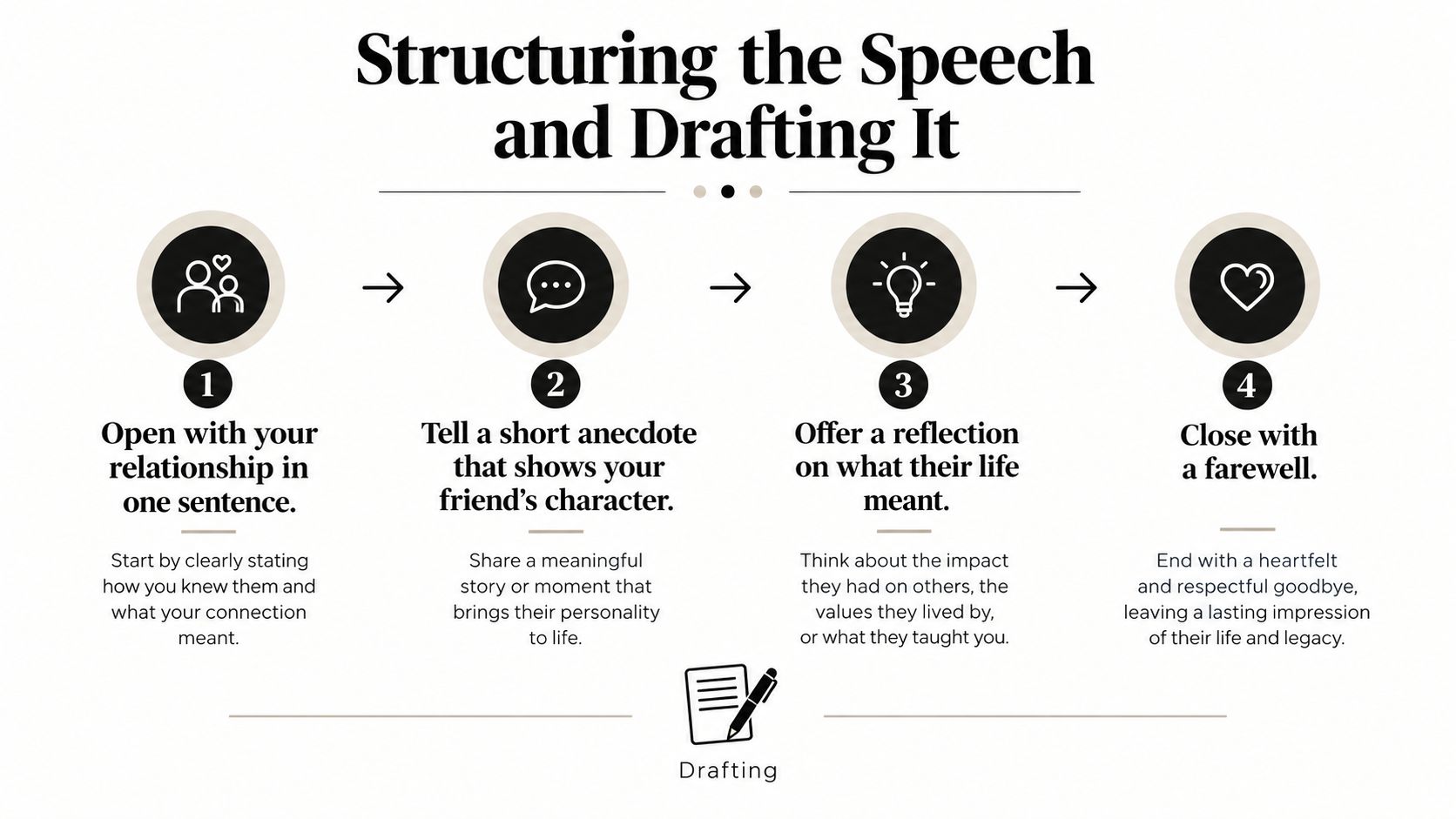
A practical four-part skeleton is enough:
- Open with the relationship. Name your friend and explain who you were to each other in one direct sentence. Follow it with a brief anecdote containing a sensory detail.
- Tell two or three contrasting stories. Choose stories that reveal different sides of the same person, perhaps a quiet moment, a funny incident, and an example of what they cared about.
- Reflect on the loss and the people closest to them. Acknowledge the absence without trying to explain it. Name the partner, parents, children, or other family members when appropriate.
- Close with farewell and invitation. Offer gratitude, leave the room with one image, and invite everyone to continue remembering together.
Draft each beat plainly
For the opening, try a line you can say:
“I'm Alex, and I had the good fortune to call Jordan my friend for many years.”
Then move quickly into a scene:
“The first thing I remember is Jordan standing in the rain outside the station, holding two umbrellas because they knew I'd forget mine.”
A transition should explain why the story matters:
“That small moment captures something I saw throughout our friendship. Jordan noticed what people needed before they asked.”
For the reflection, connect the individual memory to the wider loss:
“Jordan's death leaves a silence in our lives, but it also leaves a pattern we can recognize in one another, the habit of making room, offering help, and staying when things became difficult.”
A closing can remain simple:
“Thank you, Jordan, for the ordinary days, the impossible plans, and the friendship I'll carry with me. I hope we keep telling these stories, so the kindness you gave us continues to move through this room.”
Expert guidance commonly recommends a spoken target of 3 to 5 minutes, or roughly 500 to 750 words, and advises centering the speech on 2 to 3 specific stories rather than attempting a complete biography, as outlined in this eulogy-writing guide. Your service may allow a longer slot, and the instructions here use a target of 5 to 8 minutes, roughly 750 to 1200 spoken words, when that time has been assigned. Follow the officiant's limit first.
Circle your strongest stories before you worry about elegant sentences. If a memory supports your theme, reveals character, and can be told clearly, keep it. If it's merely interesting, cut it without guilt. Your friend's whole life cannot fit into one speech, and trying to force it in will weaken the moments that matter most.
For a practical way to arrange your ideas before drafting, use this speech outline guide. Write the first draft as though you're speaking to one trusted friend. You can refine the wording later, but you can't edit sincerity into a sentence that never came from your actual experience.
When the Friendship Was Complicated, Recent, or Private
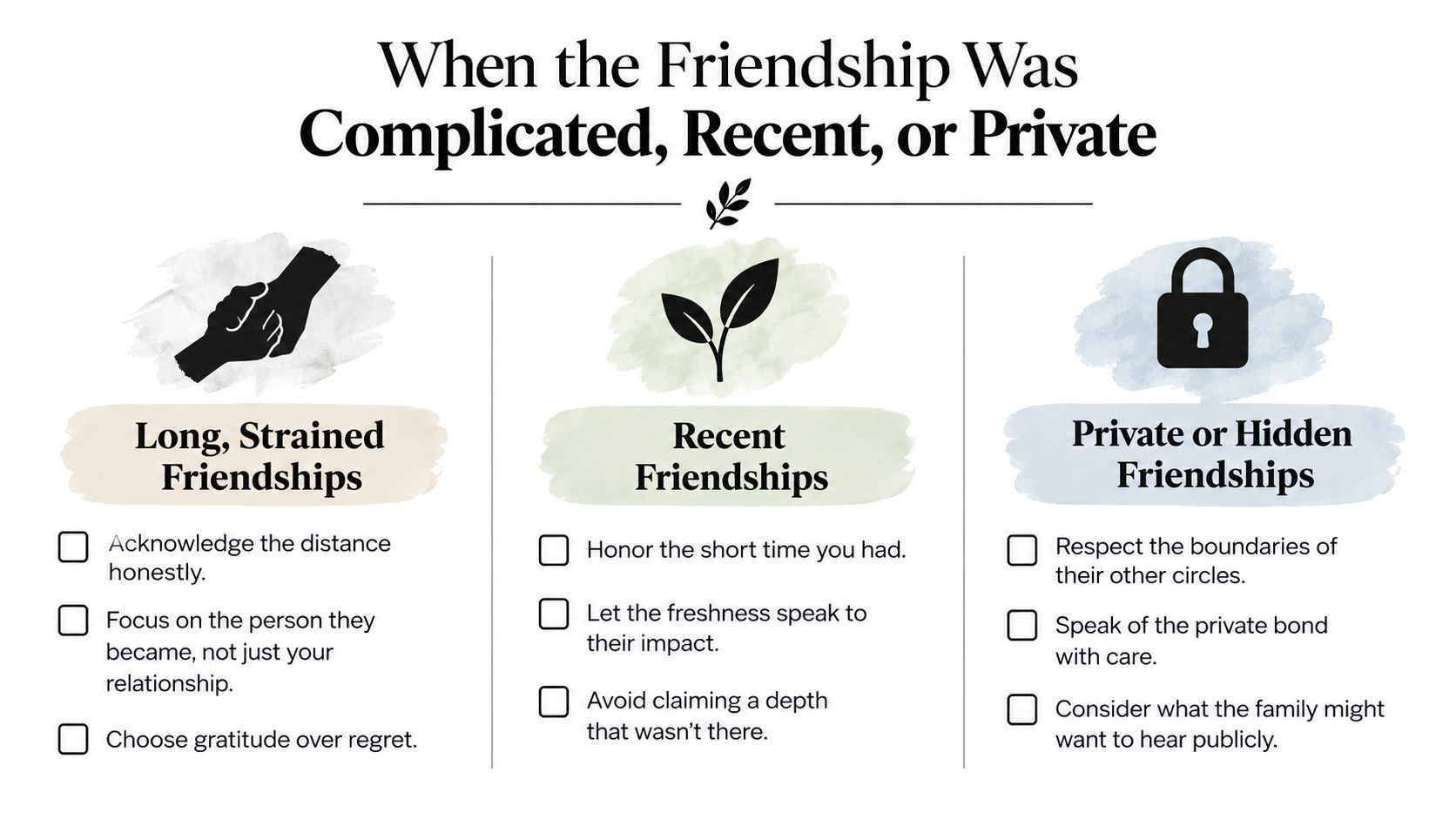
Some friendships don't fit the warm-nostalgia template. You may have been estranged when your friend died. You may have known them only briefly. You may have shared a private bond that other mourners at the funeral never knew existed. You don't need to pretend otherwise.
If the relationship had rough patches
Don't use the eulogy to settle an old argument, expose private wrongdoing, or make the room process your unresolved anger. You can acknowledge distance without recounting every cause. Focus on the person they became, the peace you reached, or the gratitude that remains.
A passage might sound like this:
“Our friendship went through a difficult season, and there was a time when we didn't know how to find our way back to each other. I'm grateful that we did. The last conversations we shared reminded me of the generosity and humor that first drew me to Sam, and I'll hold that restored connection close.”
That is honest without turning the speech into a grievance. If reconciliation never happened, you can still speak accurately: “We lost touch, but I never stopped being grateful for what that friendship gave me.” You're allowed to name complexity, but you're not required to explain it.
If the friendship was recent
Don't claim a history you didn't have. A short friendship can still be important, and its freshness may be part of the truth. Say how you met, what your friend offered, and why the time mattered.
“I only knew Priya for a short part of her life, but she had a way of making a new friendship feel immediately welcome. I'm grateful for the conversations we had, the questions she asked, and the ease she created in ordinary moments. I wish we'd had more time, but the time we had changed me.”
That kind of passage honors impact without competing with people who shared decades with the deceased.
If the friendship was private
Private does not mean unimportant, but it does require discretion. Explain the bond in language the room can enter. Replace an inside joke with the quality beneath it. Instead of repeating a phrase only two people understood, describe how it made you feel or what it showed about your friend.
Ask yourself what the family would want to hear publicly. Skip details that could expose someone, reveal a secret, or make the audience wonder whether the speech belongs at the service. Some memories are sacred because they remain yours. You can honor a relationship without giving every part of it to the room.
Rehearsing and Delivering Without Falling Apart
Writing the speech is only half the task. Delivery requires its own plan, especially when you're grieving and your body may react before your mind can steady it.
Read the eulogy aloud at least four times, then time each reading against the slot you've been given. One expert guide recommends reading aloud 5 to 10 times and printing the speech in 14 to 16 point font with double spacing, as described in these delivery recommendations for eulogy writing. Use the version that makes the page easiest for you to follow.
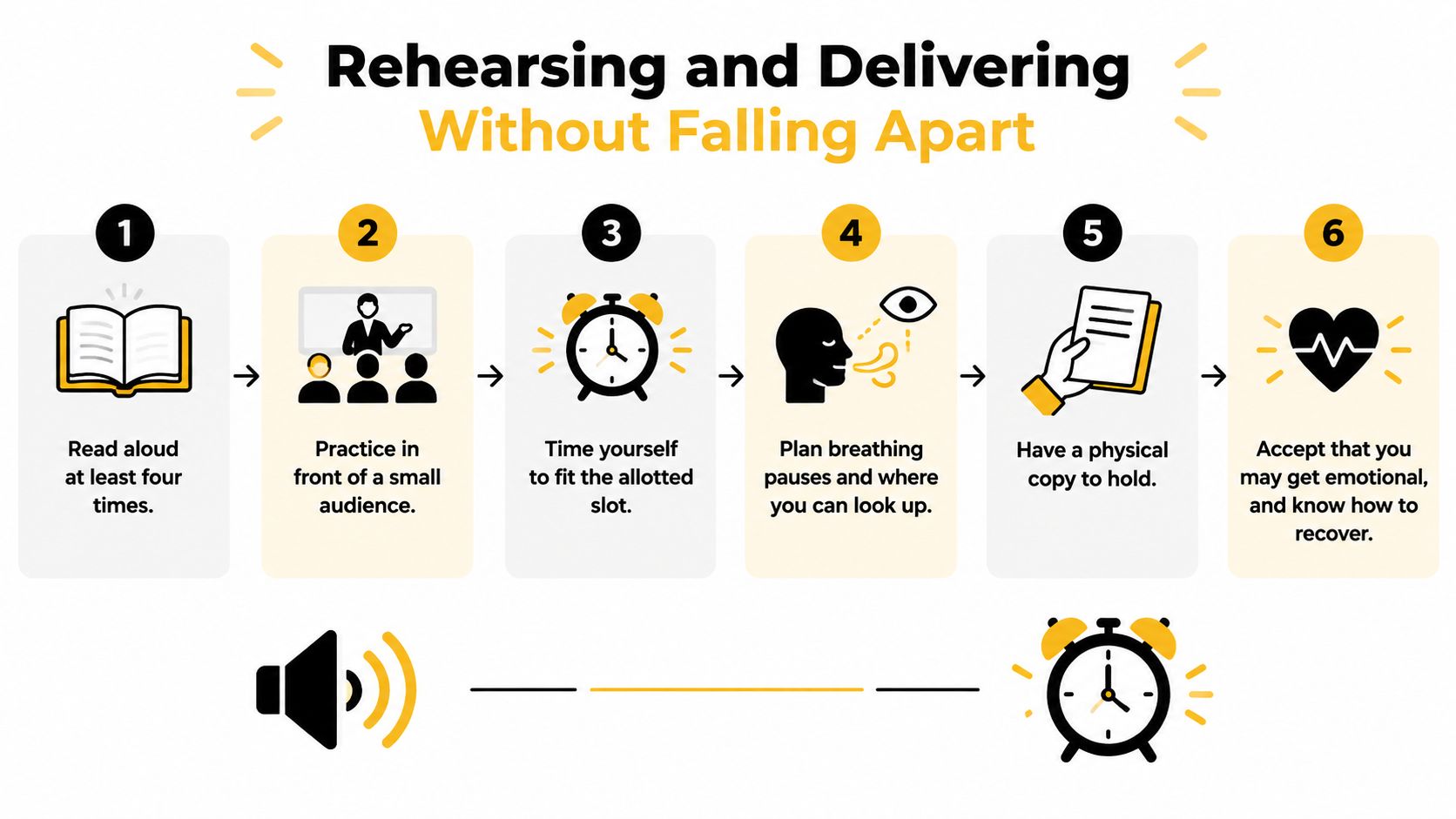
Mark the places where you'll breathe, pause, or look up. Add a slash where a sentence should stop. Number every page. Keep a second printed copy with a trusted person or the officiant, and ask someone in advance to be your backup reader.
Prepare for the reaction you fear
If you expect to cry, put water within reach and mark a sentence where you can safely stop. Tears don't mean you're failing. Pause, breathe in slowly, look at the page, and continue when you can. If the words won't come, your backup reader should already know exactly what to do.
If you're worried about dissociating or feeling detached from the room, reduce the number of decisions you'll need to make. Use short sentences, clear page breaks, and a familiar person in the front row as an anchor. Touch the lectern, feel both feet on the floor, and read the next marked line rather than trying to remember the entire speech.
If you lose your place, don't apologize repeatedly. Look down, find the next bolded or highlighted phrase, and begin again. The audience understands that this is a funeral, not a speaking contest.
Practical rule: Build the speech so you can deliver it while emotional, not only while calm.
Looking at the audience is appropriate for the opening, the most important lines, and the farewell. Reading from the page is appropriate for details, names, and any passage likely to overwhelm you. A printed script is not a sign that you're less sincere. It's a tool that lets you remain present.
Keep both hands lightly on the pages or rest one hand on the lectern. Stand where the officiant directs you, keep water nearby, and don't pace. When you finish, pause, look toward the family if that feels right, say “Thank you,” and step down slowly. You don't need to create a perfect final moment. You only need to finish safely.
Here's a visual walkthrough you can use while preparing for the physical act of speaking:
Putting It All Together Before the Day
A good eulogy rests on five decisions. You understand that the speech is a public act of remembrance, not a biography. You gather scenes before drafting. You use a clear structure so the room can follow you. You address a complicated or unusual friendship without turning the service into a confession. You rehearse the delivery as carefully as you shape the words.
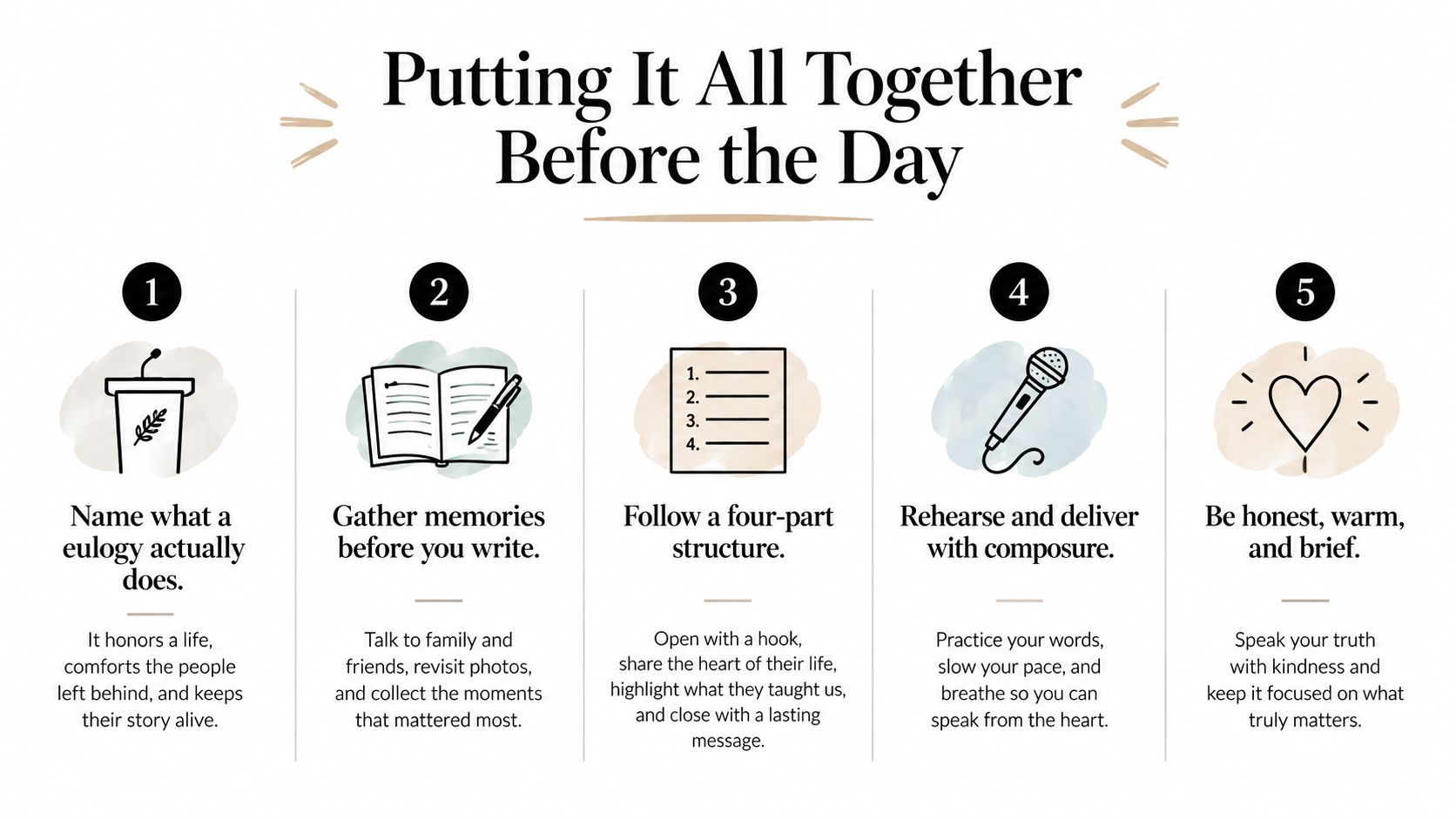
On the day, arrive early enough to learn where you'll stand and who will sit near you. Meet your backup reader if you have one, read the speech once in a quiet room, and put the printed pages in order. Check that names are spelled correctly, confirm the time limit, and keep water close.
You may shake. You may cry. You may lose your place and need help. None of that cancels the tribute. A halting, honest speech from a friend who knew and loved the person will mean more than polished words delivered without a real connection.
Your job isn't to make grief disappear. It's to give the room a few true memories to hold together. Write the sentences you can stand behind, mark the places where you'll breathe, and let the love in the voice do what perfect phrasing never could.
If the blank page is stopping you, Honored Words can guide you through questions about specific memories, inside jokes, and the tone you want, then help shape your answers into personalized eulogy drafts. Use it as a starting point, revise every line until it sounds like you, and bring the version you can say to the people gathered.
Related speech guides
Continue with a free draft for the occasion that matches this article.
Turn your story into a speech.
Answer a few guided questions, compare three personalized drafts, and edit until the words sound like you.
Start your speech