8 Wedding Speech Examples Father of the Groom
Find wedding speech examples father of the groom across heartfelt, funny, short, and reflective styles, with analysis, customization tips, and toast ideas.
You've been asked to speak at your son's wedding, and the pressure is oddly specific. You're expected to sound personal without becoming overly sentimental, funny without embarrassing anyone, and polished without sounding like you copied a template. You also need to welcome the bride, acknowledge her family, celebrate the couple, and finish before the reception loses momentum.
The best choice depends on your relationship with the groom, the atmosphere of the wedding, the people in the room, and how much humor feels natural to you. These wedding speech examples for the father of the groom compare eight distinct strategies, from emotional storytelling to gentle roasting, practical wisdom, family welcome, and graceful vulnerability.
Each example includes a short model, followed by guidance on emotional balance, audience fit, narrative structure, risks, timing, customization, and delivery. If the blank page is the hardest part, Honored Words' storytelling guide can help turn specific memories into a structured draft instead of a generic speech.
Table of Contents
- 1. The Heartfelt Storytelling Speech
- 2. The Humorous Dad Jokes and Roast Speech
- 3. The Perfect Harmony Speech
- 4. The Welcome to the Family Speech
- 5. The Life Advice and Wisdom Speech
- 6. The Journey and Growth Narrative
- 7. The Proudly Humorous Bragging Rights Speech
- 8. The Graceful Vulnerability and Reflection Speech
- Father of the Groom: 8 Speech Styles Compared
- Turn the Best Approach Into Your Own Toast
1. The Heartfelt Storytelling Speech
A childhood scene can become the thread that connects your son's past with his marriage today. Begin with one clear memory, explain the quality it revealed, and then show how that quality appears in his relationship. The speech feels personal because guests see a moment, rather than hearing a list of compliments.
Sample opening: “I still remember standing in the hallway while Daniel tried to tie his own tie before prom. It took several attempts, a great deal of concentration, and a little help from a video tutorial. Years later, I see that same determination in the way he has built a life with Emily. He's learned that commitment isn't about getting everything right immediately. It's about showing up, learning together, and choosing each other every day.”
This approach fits an intimate wedding, a reflective father, or a groom whose early experiences reveal his character. A story about learning to ride a bike can lead into the uncertainty and trust of marriage. A memory of your son helping someone else can explain why you admire the caring partner he chose.
Use guided storytelling questions to identify three or four specific memories, then keep only the strongest one or two. Record the setting, your son's action, and what you felt. Each anecdote should be brief enough to keep the speech moving. A small, lighter observation between emotional passages can keep the tone warm rather than heavy.
Strategic analysis and customization
The narrative structure works like a bridge: childhood memory, character insight, present-day relationship, welcome, and toast. Its emotional balance favors sincerity, so it suits guests who will appreciate reflection more than broad comedy. Keep the bride or groom's partner present in the story, rather than treating the marriage as an afterthought.
The main risk is nostalgia becoming a biography. Remove any detail that does not reveal something about your son or the couple. Aim for a focused timing window, and place the emotional high point shortly before the toast. Practice that transition aloud, especially the sentence linking his earlier character to his life now.
Customize the model with one sensory detail and one specific quality, such as patience, courage, or generosity. Deliver slowly, pause after the memory, and keep a written copy nearby if emotion interrupts your pace.
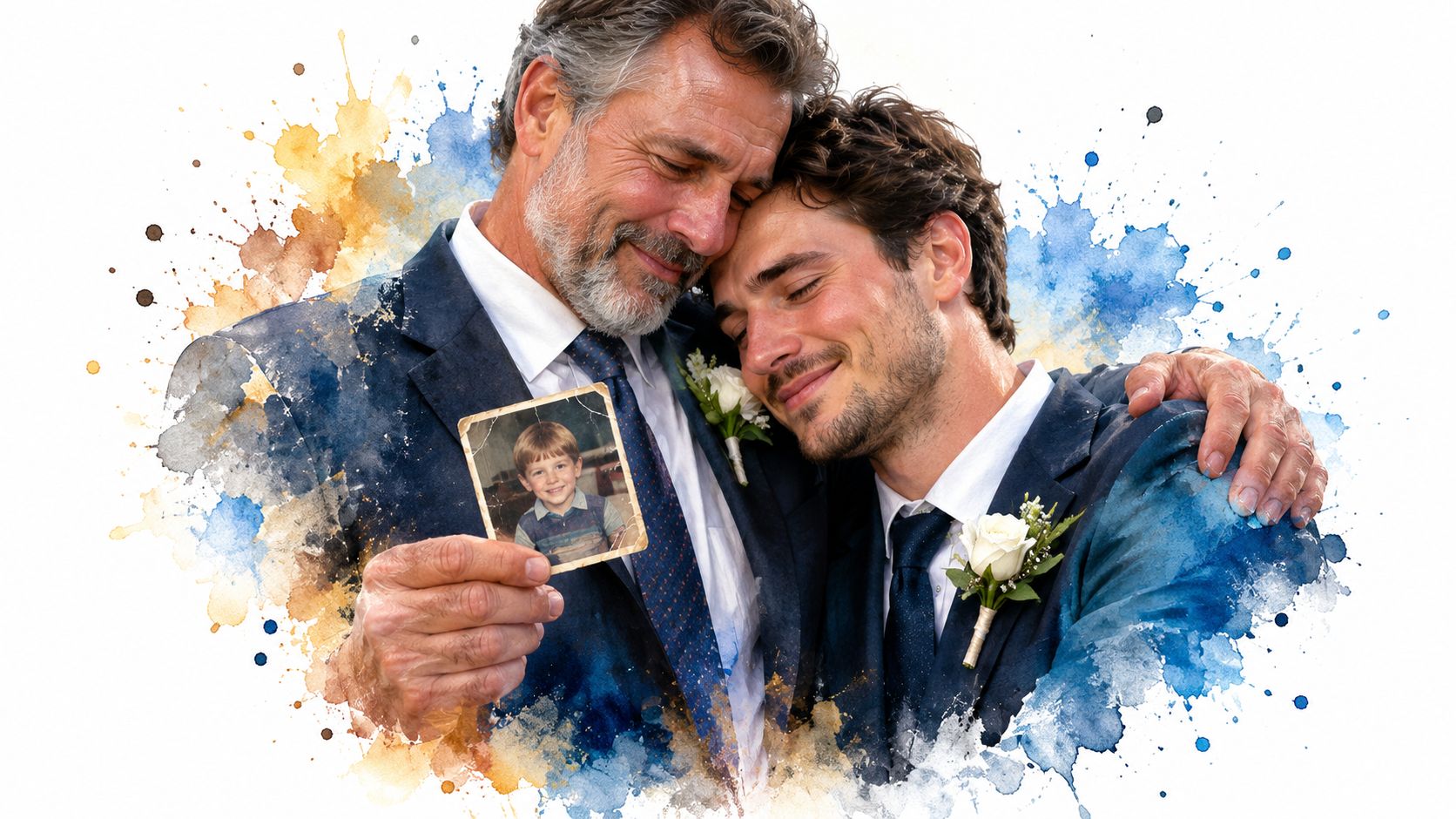
Takeaway: Choose this strategy when a true memory can explain why you are proud of the man your son has become and why his marriage feels like a natural continuation of that story.
2. The Humorous Dad Jokes and Roast Speech
A humorous speech works when the laughter reveals affection. The father gently teases the groom's habits, oddities, or history, then turns that humor toward a sincere welcome for the bride. The result should feel like a loving family portrait, not a performance at the groom's expense.
“Before Hannah met Liam, I believed his cooking had reached its natural limit. He could make toast, boil pasta, and order delivery with impressive confidence. Then Hannah came along, and suddenly he learned that a kitchen contains more than one appliance. Hannah, thank you for believing in him. Liam, remember that marriage is about compromise, so you'll be cooking at least one meal before she has to ask.”
That example works because the target is harmless, the bride is included, and the ending turns toward marriage rather than staying focused on the joke. A playful comment about poor organization, terrible puns, or an overcomplicated morning routine can land well when guests recognize the affection behind it.
Strategic analysis and customization
This strategy fits casual receptions, outgoing families, and grooms who enjoy being teased. Build around three funny moments and one or two sincere acknowledgments of the bride. Humor can carry the middle, while the opening and close establish warmth.
Avoid ex-partners, money problems, family conflicts, drinking stories, controversial subjects, and anything the groom would find humiliating. If a joke needs a long explanation, it probably belongs in private. Test the material with someone who understands the audience, not only with a family member who already knows every reference.
Use a balanced tone rather than maximum roast energy. Honored Words' roast-writing guidance can help you shape jokes that remain affectionate and wedding-appropriate.
“A good roast should make the person feel loved after the laughter ends.”
Takeaway: Roast the habit, not the character. Leave the room laughing, then give the couple a sincere reason to raise their glasses.
3. The Perfect Harmony Speech
The Perfect Harmony speech alternates between humor and feeling, so neither tone has to carry the entire address. It's often the safest choice when you want broad audience appeal because it gives the groom's family a laugh, gives the bride's family a genuine welcome, and gives the couple a meaningful close.
“Teaching Oliver to drive taught me two things. First, he has always been confident under pressure. Second, I should have checked my insurance policy first. Today, I trust him with choices far more important than parallel parking. I've watched him become thoughtful, patient, and dependable, and I've seen those qualities deepen since he met Grace. His childhood room may have been chaotic, but his life has found its direction.”
The narrative works because the humorous incident leads to a serious observation. A joke about a messy bedroom can introduce the idea that the groom has grown into a responsible partner. A story about dating misadventures can become a sincere acknowledgment that he has finally found the person with whom he can build a life.
Strategic analysis and customization
Use this sequence:
- Warm opening: Welcome guests and establish your relationship to the groom.
- Humorous anecdote: Tell one scene with a clear, gentle punchline.
- Emotional turn: Explain what the story shows about his growth.
- Second lighter moment: Restore energy without changing the subject.
- Strong close: Address both partners and offer a toast.
Keep the jokes in the middle, where they can refresh attention. Place emotional material near the opening and ending, and pause after important lines so the audience can respond. Every joke should support the speech's larger idea, such as growth, partnership, or finding balance.
Read the speech aloud several times. Tonal changes that seem smooth on the page can sound abrupt when spoken. The father-of-the-groom guidance from Speechy describes a familiar progression from welcome and childhood stories to honoring the adult groom, acknowledging his partner, and ending with a toast.
Takeaway: Choose Perfect Harmony when you want humor to open the room and sincerity to stay with it.
4. The Welcome to the Family Speech
This speech gives the bride and her family the center of attention. You still speak about your son, but the main purpose is to show that the marriage expands your family rather than adding someone to it. The strongest version names the bride directly and offers a welcome based on something you've observed.
“From the first family dinner, Maya brought a calmness and kindness that made everyone feel comfortable. She noticed when people needed help, remembered the stories we'd told her, and made Noah laugh in a way we hadn't heard for years. Maya, we're grateful for the way you love our son, and we're grateful for the person you are. To your parents, thank you for raising someone who has already become such an important part of our family.”
This approach works especially well when the bride has a visible positive influence on the groom. You might describe how she encouraged his patience, brought out his thoughtfulness, or joined family traditions with genuine enthusiasm. A shared moment at a holiday gathering can provide more warmth than broad praise.
Strategic analysis and customization
Before drafting, identify two or three specific ways the bride has affected the groom or your family. Mention her name naturally throughout the speech, and compliment a quality that exists beyond her role as the groom's partner. You might recognize her generosity, humor, steadiness, curiosity, or ability to make people feel included.
Address the bride's parents directly if the setting allows it. Thank them for raising her, then connect that gratitude to the family joining together. Keep the groom present by explaining how the relationship has helped him grow or shown his readiness for marriage.
The main risk is sounding as though the bride is being evaluated for admission. Avoid language that suggests she has earned permission to belong. Speak as though the family is celebrating a bond that's already meaningful.
Takeaway: Choose this style when your most important message is, “We see you, we value you, and we're delighted that our families are joining.”
5. The Life Advice and Wisdom Speech
A wisdom speech can be meaningful when it sounds like a gift, not a lecture. The father shares lessons drawn from experience, admits that he hasn't always handled everything perfectly, and then connects those lessons to the couple's future.
“One thing I've learned is that a strong partnership isn't built by agreeing about everything. It's built by remembering that the relationship matters more than winning the argument. I haven't always remembered that as quickly as I should have, but I've learned from the times when I did. Daniel and Sofia, keep making room for each other's plans, worries, successes, and mistakes. You don't have to become the same person. You have to remain on the same side.”
The example offers guidance without pretending to possess a formula for marriage. Other themes might include protecting time together during demanding seasons, supporting each other through career changes, or maintaining individual interests within a committed relationship.
Strategic analysis and customization
Use the phrase “what I've learned” more often than “what you should do.” That small change lowers the risk of sounding authoritative and makes the advice feel earned. Include one moment of vulnerability, such as a mistake you made, a time you misunderstood your partner, or a lesson that took you longer to recognize.
Keep each lesson connected to the groom or the couple. Advice that could be given to any newlywed pair will feel generic unless it follows a specific observation about them. Light humor can help, but it should support the human story rather than interrupt it.
The father-to-son wedding speech guide from Honored Words can help organize personal experience into a speech that welcomes the partner and ends with a forward-looking wish.
Practical rule: Offer perspective, not instructions. Your son should feel trusted to build his own marriage.
Takeaway: Choose wisdom when you have a personal lesson that can encourage the couple without claiming to know their future better than they do.
6. The Journey and Growth Narrative
The journey speech traces the groom's development from childhood to adulthood. Instead of treating memories as separate anecdotes, it gives them a clear direction. Each stage should reveal a quality that matters in marriage, such as resilience, empathy, loyalty, patience, or responsibility.
“When Ethan was young, he was quiet and observant. He became determined as a teenager, especially when he decided to train for a sport that didn't come naturally. As an adult, that determination became resilience. He learned to listen, to support people through difficult moments, and to keep going when plans changed. Then he met Priya, and I saw those qualities become part of a partnership. He wasn't only building a life for himself anymore. He was building one with someone else.”
This format suits a father with many meaningful memories and a groom whose growth is central to the family story. The chronological movement also helps guests who know the couple but haven't known the groom for long.

Strategic analysis and customization
Map four or five key life moments before writing, then choose one scene for each important phase. Don't list every school, job, move, or accomplishment. A moment earns its place when it demonstrates a quality that connects to the marriage.
Use clear transitions such as “As he grew,” “Years later,” or “That same quality appeared again.” Keep childhood and adolescence concise, then give more room to adulthood, the relationship, and the couple's future. The speech should culminate in the present, not end with the groom as a child.
The main risk is chronological drift. If an anecdote doesn't show development, remove it. A timeline without a point feels like a family archive; a timeline built around character becomes a story.
Takeaway: Choose this structure when the groom's life seems to have a clear arc from early traits to adult readiness.
7. The Proudly Humorous Bragging Rights Speech
This speech lets a father celebrate his son openly, with enough self-awareness to keep pride from becoming a résumé. The best examples praise qualities that matter in marriage, not only professional or academic achievements.
“I'm proud of Marcus for many reasons. He has worked hard, kept his promises, and become the kind of person people call when they need help. I'd like to say all of that comes from me, but his mother is in the room, and we both know how this family keeps score. Laura, you're marrying someone with ambition, loyalty, and a dependable heart. Marcus, you're marrying someone whose strength and kindness match your own. We couldn't be happier for you both.”
The humor comes from the father's proud-dad perspective, not from pretending the achievements are unimportant. A playful comment about not expecting the groom to reach a milestone can work if the affection is obvious and the joke doesn't undermine him.
Strategic analysis and customization
Open with genuine pride. Don't hide behind irony, because the audience needs to understand what you admire before the jokes begin. For every accomplishment you mention, connect it to a quality that supports a lasting partnership, such as reliability, generosity, patience, or integrity.
Include the bride as an equally important part of the celebration. Praise what she contributes and explain why the match feels right. The speech should never sound like you're presenting your son for approval or suggesting that the bride has won a prize.
The risk is overstatement. Listing achievements without scenes or emotional context can make guests feel like they're hearing a professional profile. Replace one broad compliment with one short example that proves it.
Takeaway: Choose this approach when your pride is the central emotion, but make the celebration about character and partnership rather than status.
8. The Graceful Vulnerability and Reflection Speech
A father watches his son move from needing guidance to making independent choices. A graceful vulnerability speech gives that transition honest words while keeping the wedding centered on the couple. Its emotional balance is reflective rather than comic, so it suits close families, mature audiences, and receptions where a sincere pause will feel natural.
“I remember when Jack needed me to hold his hand crossing the street. Later, he wanted advice about every decision. Gradually, he began making those decisions himself. Watching him stand beside Elena today, I feel the tenderness of each stage, and I also feel proud. Jack, you have become someone who can offer love, steadiness, and partnership. Elena, thank you for sharing this next chapter with him. I'm excited to see the life you build together.”
The example follows a simple arc: childhood memory, recognition of change, confidence in the groom, then welcome and hope for the marriage. Concrete details give the emotion a solid place to stand. A held hand, a first day of school, or a quiet moment when your son no longer needed direction will feel more personal than a list of general compliments.
Strategic analysis and customization
Keep the reflection contained. One focused memory can open a window into the father-son relationship. Several childhood stories may turn the toast into a farewell. After the emotional center, point clearly toward joy, partnership, and the couple's future.
Use little humor, perhaps one gentle observation about your own changing role. The aim is release, not a second comedy routine. Audience fit matters too. In a formal or intimate room, a measured pause can deepen attention; in a highly energetic reception, keep the reflection shorter and make the final toast especially clear.
Practice the transition from feeling to celebration. If emotion rises, breathe, look at the couple, and continue when ready. Do not apologize for becoming moved, and do not rush through the sentence that carries your main message.
Advice from father-of-the-groom speech advice from The Knot places the toast within a concise reception format, with attention to welcoming the partner, speaking about the groom, and ending with a toast. That structure works like a short bridge: reflection forms one side, confidence in the newlyweds forms the other.
Takeaway: Choose this strategy when your central message is that you recognize the change, cherish the past, and trust the life your son and his partner will build together.
Father of the Groom: 8 Speech Styles Compared
| Speech Style | Implementation Complexity | Resource Requirements | Expected Outcomes | Ideal Use Cases | Key Advantages |
|---|---|---|---|---|---|
| The Heartfelt Storytelling Speech | Medium, needs curated anecdotes and emotional pacing | Personal memories, guided questions, rehearsal, tight editing | Strong emotional connection, lasting sentimental impact | Traditional, close-knit, multigenerational, formal weddings | Deep resonance, easy to personalize, timeless |
| The Humorous "Dad Jokes & Roast" Speech | Medium–High, requires comedy timing and calibration | Joke testing, audience preview, confident delivery | High engagement, frequent laughter, lively atmosphere | Casual, younger crowds, laid-back families, modern receptions | Energetic, memorable, showcases speaker personality |
| The Perfect Harmony Speech (Balanced) | High, careful balancing of humor and sentiment | Multiple anecdotes, comedic beats, extensive rehearsal | Broad appeal, steady engagement, well-paced arc | Mixed-age gatherings, formal yet warm ceremonies | Versatile, balanced, widely accessible |
| The "Welcome to the Family" Focused Speech | Low–Medium, straightforward but must balance focus | Knowledge of bride/family, guided prompts, name mentions | Inclusive tone, improved in-law dynamics, welcoming atmosphere | Blended, interfaith/intercultural weddings, establishing in-law bonds | Strengthens family relationships, modern and egalitarian |
| The Life Advice & Wisdom Speech | Medium–High, needs vulnerability without lecturing | Personal reflections, select anecdotes, careful phrasing | Memorable, quotable insights, sense of guidance and gravity | Audiences valuing substance, traditional or intentional couples | Deep authenticity, meaningful takeaways, fatherly guidance |
| The Journey & Growth Narrative Speech | High, structured chronology and smooth transitions | Multiple life stories, timeline mapping, strict editing | Compelling narrative arc, clear depiction of growth | Storytelling-oriented families, legacy-focused ceremonies | Shows development over time, emotionally satisfying arc |
| The Proudly Humorous "Bragging Rights" Speech | Low–Medium, balance pride and humility | List of achievements, humor calibration, guided questions | Celebratory tone, validation of groom's accomplishments | Achievement-oriented families, accomplished grooms | Authentic pride, positive and affirming atmosphere |
| The Graceful Vulnerability & Reflection Speech | Medium, requires emotional control and authenticity | Introspection, practice for composure, concise vulnerability | Profound emotional resonance, authentic connection | Emotionally mature audiences, formal meaningful ceremonies | Deeply moving, validates complex parental feelings |
Turn the Best Approach Into Your Own Toast
You don't need to combine all eight approaches. Choose one primary strategy that matches your relationship with your son and the mood of the wedding. A heartfelt story can carry a small joke. A roast can finish with an emotional sentence. A wisdom speech can include a funny admission. The main style should give the speech a recognizable emotional center.
Start with two or three specific memories. Choose scenes rather than summaries, and ask what each memory reveals about the groom. Did he show loyalty, patience, curiosity, courage, generosity, or persistence? Then connect those qualities to the person he is today and to the relationship he's building.
Name the bride directly and welcome her meaningfully. Mention something specific about her character, not only the fact that she's your son's partner. If appropriate, acknowledge her parents and family as people joining your celebration. The audience should hear that you're honoring both sides of the couple.
End with a clear toast. Address both partners by name, offer one forward-looking wish, raise your glass, and stop. A concise ending often feels more powerful than adding another paragraph after the emotional high point.
Final preparation checklist
- Check the timing: Father-of-the-groom guidance varies, with recommendations ranging from about 5 to 10 minutes and roughly 900 to 1,200 words in one UK speechwriting guide, while The Knot recommends no more than 4 to 6 minutes. Use the couple's schedule and the other speakers to choose a realistic target.
- Edit heartfelt material: Keep the memories that reveal character and remove repetition.
- Set roast boundaries: Cut jokes about exes, money troubles, private conflict, or anything that could embarrass the couple.
- Keep advice humble: Frame lessons as personal experience rather than commands.
- Structure a timeline: Give every life stage a purpose and a smooth transition.
- Practice aloud: Test the opening, emotional turns, laughter pauses, and final toast with a trusted listener.
- Confirm the welcome: Say the bride's name, acknowledge her family, and make the couple central.
- Prepare your notes: Use a readable page or cue card, and mark the sentences where you need to look up.
If blank-page panic is holding you back, Honored Words can use guided questions to draw out memories and inside jokes, generate multiple drafts in different tones, preview openings, and support revisions for a personalized father-of-the-groom speech. You can start with the style that feels closest to you, then adjust the balance of warmth, humor, and sentiment until the words sound natural in your voice.
Honored Words helps you turn specific family memories into a polished wedding speech, with guided questions, tone-based drafts, and revision support for father-of-the-groom toasts. Visit Honored Words to begin shaping your personal speech.
Related speech guides
Continue with a free draft for the occasion that matches this article.
Turn your story into a speech.
Answer a few guided questions, compare three personalized drafts, and edit until the words sound like you.
Start your speech