How to Write a Great Speech for Any Event
Learn how to write a great speech for weddings, memorials, and milestones. Follow a clear process for planning, structuring, and delivering with confidence.
You've agreed to give the wedding toast, eulogy, graduation address, or family tribute. Then the blank page appears, and every sentence sounds either painfully generic or suspiciously borrowed. You don't need to become a professional writer overnight. You need a reliable way to find the right memories, shape them into a simple story, and rehearse the result until it sounds like you.
Table of Contents
- Why Most Speeches Fall Flat and How to Fix Yours
- Mining Your Memories for Speech Material
- Structuring Your Speech for Maximum Impact
- Calibrating Tone and Humor for Your Audience
- Editing and Rehearsing Without Losing Authenticity
- Last-Minute Speech Solutions and Quick Templates
Why Most Speeches Fall Flat and How to Fix Yours
Most weak speeches fail for a simple reason: they praise a person in broad terms without showing the audience why that praise is true. “She's kind, loyal, and wonderful” may be accurate, but it gives listeners nothing to see, feel, or remember. A story about her driving across town late at night to help a frightened friend does far more work.
A widely cited public-speaking benchmark places recall for plain facts at only 5% to 10%, compared with 25% to 30% when visuals are added and 65% to 75% when a message uses stories, examples, and emotion. The figures come from public-speaking guidance on audience memory and attention, and they point to a practical rule: build your speech around moments, not adjectives.

Start with a moment that carries meaning
Suppose you're giving a best man speech. You could list the groom's virtues, then describe the couple as perfect together. Or you could tell the story of the night he stayed on the phone while you worked through a personal crisis, even though he had an early morning and no solution to offer. That memory proves loyalty without announcing it.
The same approach works at a memorial. Don't begin with an inventory of achievements. Begin with the ordinary detail everyone who loved the person will recognize, such as the way they greeted visitors, saved leftovers, or turned an awkward silence into laughter. Specificity makes private love understandable to a room full of people.
The first several minutes deserve special care because the same source places average audience attention at only 8 to 10 minutes. That doesn't mean your speech must end there, but it does mean your opening should establish the emotional direction quickly. Skip the long apology, the unnecessary biography, and the warm-up that says nothing.
Practical rule: If a sentence could describe almost anyone at the event, replace it with a memory only you could tell.
A great speech isn't a test of literary brilliance. It's an act of selection and arrangement. Choose a few meaningful moments, show what happened, explain what those moments reveal, and let the audience arrive at the feeling with you.
Mining Your Memories for Speech Material
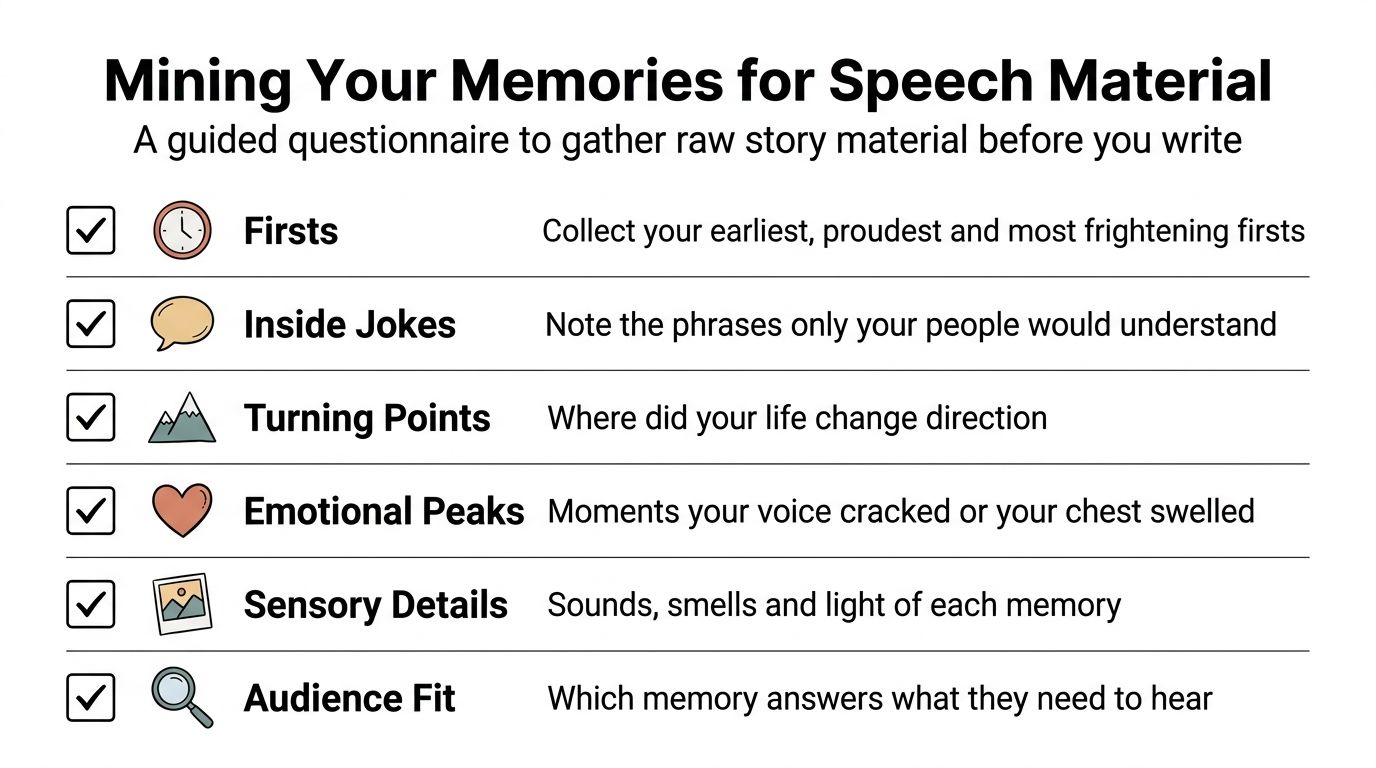
Don't draft the opening first. That's where nervous non-writers get trapped. Start with raw material, because a strong speech usually emerges from a collection of concrete memories rather than from forced inspiration.
Set a timer, open a blank document, and answer questions quickly. Don't polish. Write fragments, names, places, objects, and lines people said.
Use prompts that produce scenes
For a wedding speech, ask:
- First encounters: When did you meet the person, and what did you notice first?
- Unexpected behavior: When did they surprise you, embarrass you, or make you laugh uncontrollably?
- Proof of character: When did they help someone without seeking credit?
- Relationship change: What moment shifted your friendship from casual to important?
- The couple's pattern: What small habit shows how these two care for each other?
- Future meaning: What do you hope they carry into married life?
For a eulogy, change the focus:
- Daily rituals: What did they do so often that the family now notices its absence?
- Private language: What phrase, nickname, or joke belongs to them?
- Hard seasons: When did they show courage, patience, or generosity?
- Sensory memory: What did their home smell like, what music played, or how did their laugh sound?
- Inherited qualities: What part of them do you see continuing in the family?
- Unfinished gratitude: What do you wish you'd said while they were alive?
Graduation speeches benefit from questions about uncertainty, setbacks, mentors, and the moment a difficult path became worthwhile. A parent's toast can focus on childhood scenes that reveal the adult standing in front of the room.
Gather evidence before you trust your memory
Ask relatives or close friends for one story you may have forgotten. Search old messages, photo captions, cards, and family group chats. Look for a moment with a beginning, a change, and an emotional consequence, not merely an amusing incident.
You're not trying to include everything. Select two or three stories that show different sides of the person and support one central idea. One story might reveal humor, another generosity, and a final one the relationship's deeper meaning.
Read this guide to storytelling in speeches for another way to distinguish a useful anecdote from a disconnected memory.
Use the video below as a practical prompt for thinking about narrative, delivery, and audience connection.
Now make a short “story bank.” For every candidate memory, note who was there, where it happened, what changed, the precise detail you remember, and what the audience should understand afterward. The blank page becomes much less intimidating when you're choosing from material instead of inventing from nothing.
Structuring Your Speech for Maximum Impact
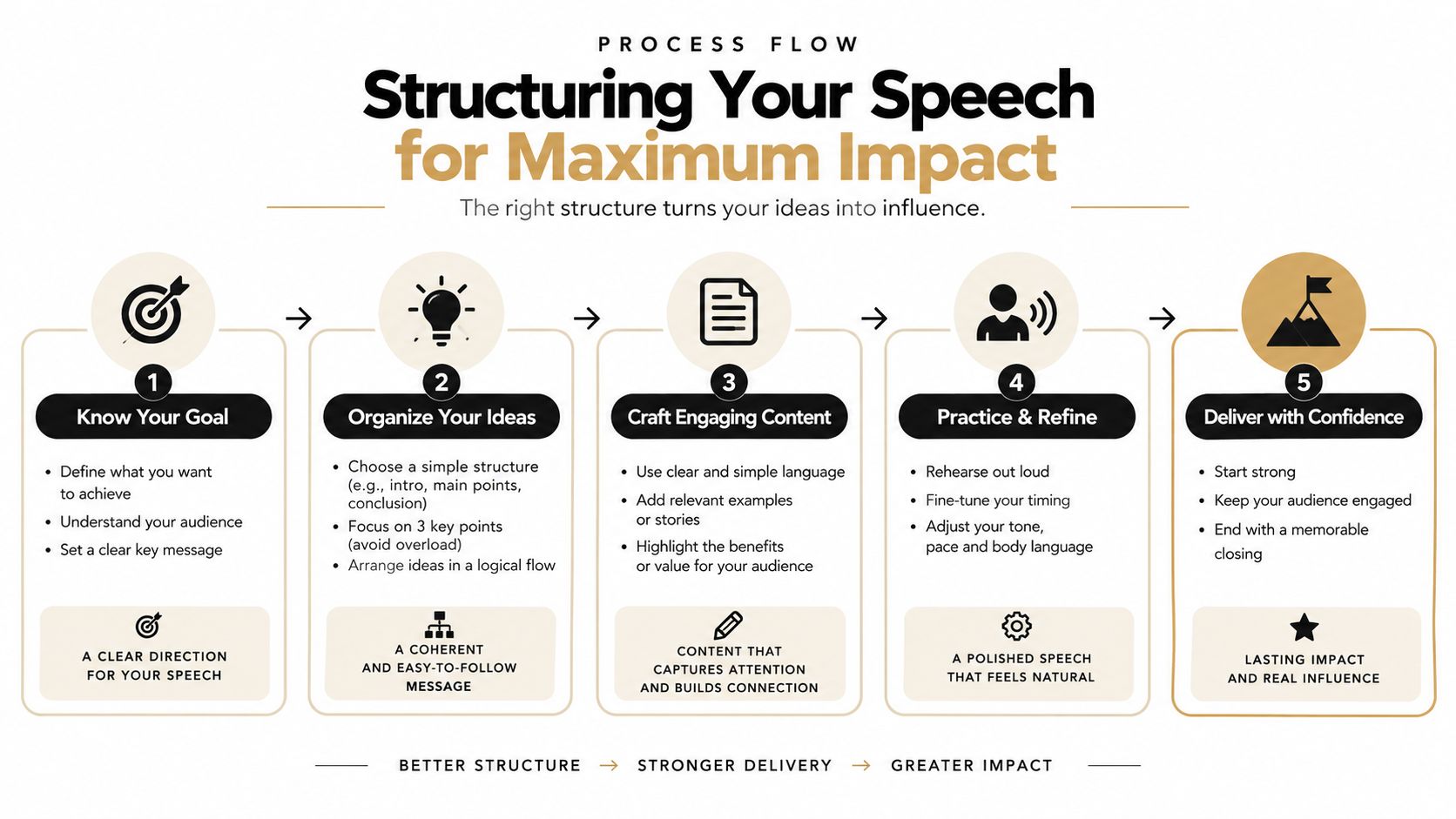
Structure is a delivery aid, not a prison. When you know the route, nerves are less likely to send you into a long detour.
Use a simple three-part architecture:
- Opening: Establish the idea and earn attention.
- Body: Tell the few stories that prove the idea.
- Close: Return to the idea and give the room somewhere emotional to land.
Build an opening with immediate purpose
A wedding toast might open with: “I learned what kind of friend Daniel was during the week my life fell apart. He didn't give a speech about loyalty. He showed up with coffee, a spare key, and nowhere else to be.”
A eulogy could begin: “My grandmother believed no visitor should leave her house hungry. That rule explains more about her life than any list of accomplishments could.”
A graduation address might start with a failed plan: “For most of this year, I thought success meant never changing direction. Then one difficult decision taught me that progress can look like starting again.”
These openings work because they create a question. What happened next? Why does this memory matter? How will it connect to the person or occasion?
Make the body a sequence of revelations
Don't march through someone's entire life chronologically unless chronology is essential. Arrange stories by emotional function instead:
- The first story establishes character. Show the trait you want the audience to recognize.
- The second story complicates or deepens it. Let the person be funny, flawed, brave, or unexpectedly tender.
- The final story widens the meaning. Connect the private memory to the couple, family, class, or community.
Use short transitions that tell listeners why they're hearing the next story. “That was the first time I understood her generosity.” “Years later, he showed the same quality in a completely different way.” These lines keep the audience oriented without sounding like a formal outline.
A callback can give the speech a satisfying shape. If your opening mentions a spare key, a kitchen table, or a particular phrase, bring that detail back in the final paragraph with a changed meaning.
For a more detailed planning method, use this guide to writing a speech outline.
End with meaning, not a performance
The close should answer the emotional question raised at the beginning. Don't force a grand declaration if your stories have already done the work.
A best man might say, “I used to think friendship meant knowing someone's history. Watching Daniel and Priya together has taught me that it also means trusting the future they're building.”
A memorial speaker might close with, “We'll miss the big milestones, but we'll also miss the small invitations to be better, kinder, and less hungry.”
A graduate can close by naming a next action: carry a lesson, call a mentor, make room for uncertainty, or help someone else through the obstacle you've just survived.
Write the final sentence separately. It deserves clean language, a natural rhythm, and no clutter. Then stop. A strong ending loses power when the speaker keeps explaining it.
Calibrating Tone and Humor for Your Audience
Humor is seasoning, not the meal. The right joke makes a person feel known. The wrong joke makes the room calculate whether you've misunderstood the occasion.
Start with three questions: Who is listening? What does this event require emotionally? What can the subject comfortably laugh about? Your relationship matters too. A sibling may get away with teasing that would sound presumptuous from a colleague or distant friend.
A best man speech can be playful, but the groom shouldn't be the only target. Share the joke with him, then turn toward admiration. A father-of-the-bride toast often benefits from affectionate humor about childhood, followed by sincere recognition of the adult relationship being celebrated. A memorial tribute can include laughter because grief contains love, but the humor should illuminate the person rather than compete with the loss.
| Event Type | Humor % | Sentiment % | Key Considerations |
|---|---|---|---|
| Best man speech | 40% | 60% | Tease habits, not wounds. Include the partner and end with respect. |
| Father-of-the-bride toast | 30% | 70% | Use family humor carefully, then focus on pride and welcome. |
| Maid of honor speech | 35% | 65% | Balance shared history with the couple's present relationship. |
| Memorial tribute | 20% | 80% | Let gentle humor reveal warmth, not minimize grief. |
| Graduation speech | 25% | 75% | Use humor to make uncertainty approachable, then offer direction. |
These percentages are writing targets, not scientific measurements. Treat them as tone sliders. Move toward more humor when the room is relaxed and your material is inclusive. Move toward more sentiment when people are grieving, emotionally raw, or meeting you for the first time.
Test every joke with a simple filter:
- Would the subject laugh if they heard this privately?
- Does the audience understand the context?
- Does the joke reveal affection or merely expose information?
- Will the story still matter if the laugh doesn't arrive?
Avoid inside jokes that leave most listeners outside the relationship. Give just enough context for everyone to participate. For more techniques, see this guide to writing funny speeches.
The safest humor is self-aware. Tell on yourself, admit what you misunderstood, or describe your own poor decision. That approach lowers the risk of making someone else carry the embarrassment.
Editing and Rehearsing Without Losing Authenticity
Your first draft should sound too long. That's normal. Editing turns a pile of memories into a speech with momentum, but don't polish away the phrases that make it sound like you.
Read the draft aloud and mark every sentence that repeats an earlier point. Cut greetings that don't serve the occasion, explanations the audience can infer, and details that don't change the story. Keep the concrete nouns, active verbs, and lines people said.
Edit for the ear
A speech is heard once. Long sentences, nested explanations, and abstract transitions are harder to follow aloud than they look on a screen.
Use this editing pass:
- Circle the point: Write the speech's central idea in one sentence.
- Underline proof: Mark the moments that demonstrate that idea.
- Remove detours: Cut stories that are entertaining but irrelevant.
- Shorten the runway: Reach the first meaningful memory quickly.
- Protect your voice: Keep contractions, familiar expressions, and natural imperfections.
Read each paragraph as though you're speaking to one supportive person. If you wouldn't say it to them, rewrite it. Your objective isn't flawless prose. It's a clear, emotionally honest voice.
Rehearse the route, not every syllable
Practice from a page containing story titles, transition phrases, and the final sentence. Memorizing every word can make a forgotten phrase feel like a disaster. Knowing the route lets you recover naturally.
Public-speaking anxiety research described by the University of Nevada, Reno Writing and Speaking Center found a negative, moderate correlation between anxiety and speech duration. In practical terms, nerves can push speakers toward shorter delivery. Protect the details that carry warmth by marking them clearly in your notes.
Use a timer, but don't chase speed. Mark breath points with slashes, underline words that deserve emphasis, and place a visible pause before and after any important statistic. Guidance on using statistics in a speech recommends rounding complex figures, repeating the key number once, making it concrete, and slowing slightly so listeners can process it.
Practice once standing up, once with a trusted person, and once in the approximate room if possible. If your voice cracks during the speech, pause, breathe, look at someone kind, and continue. Emotion doesn't ruin authenticity. Apologizing repeatedly for having emotion usually does.

Last-Minute Speech Solutions and Quick Templates
When time is short, don't attempt a perfect biography. Use a compact story formula:
Opening idea: “I understood what [person] was like when…”
Story: Describe one specific scene, including the place, action, and detail you remember.
Meaning: “That moment showed me…”
Second beat: Add a contrasting memory that reveals another side.
Close: Return to the opening idea and offer a wish, tribute, toast, or call to action.
A template works when you already know the memories. If you're frozen, a guided questionnaire is faster than staring at an empty document. An AI tool can ask targeted questions about the person, occasion, relationship, inside jokes, and desired tone, then help turn your answers into multiple drafts. You should still verify every detail, remove anything that doesn't sound like you, and add the human phrasing the tool couldn't know.
For quality control, compare drafts rather than accepting the first version. Keep the strongest opening from one, the most vivid story from another, and the most natural closing from a third. Then read the combined version aloud and revise until the language belongs to you.
Honored Words uses guided questions to draw out personal memories and inside jokes, generates three draft options, and supports AI-assisted editing and revisions for milestone speeches. It also offers a free preview of personalized openings, so you can judge the direction before committing.
Use Honored Words when you need guided help turning real memories into a polished wedding speech, memorial tribute, or milestone address. Start with the questions, choose the tone that fits your room, and make the final draft sound unmistakably like you.
Related speech guides
Continue with a free draft for the occasion that matches this article.
Turn your story into a speech.
Answer a few guided questions, compare three personalized drafts, and edit until the words sound like you.
Start your speech