Does the Maid of Honor Give a Speech What to Expect
Does the maid of honor give a speech? Learn when she speaks, how long it should be, what to say, and easy templates to write it fast.
Yes, in most modern U.S. and U.K. weddings, the maid of honor is expected to give a short speech, usually about 2–3 minutes, but it's customary rather than mandatory, and the couple can skip or adapt it. Some etiquette guides allow up to 5 minutes, while others describe a 5–7 minute format, so the exact expectation depends on the reception plan.
You've just been asked to be maid of honor. You said yes before thinking twice, celebrated with the bride, and then, perhaps later that evening, searched, “Does the maid of honor give a speech?” That question doesn't mean you're unprepared. It means wedding customs have changed, and different couples build their receptions in different ways.
Your job isn't to follow one rigid rule. It's to find the right fit for this couple, this wedding format, and this room. By the time you finish, you'll know how to confirm whether you're speaking, where you may fit in the order, how long to aim for, what to say, and what to do if a solo speech makes your stomach drop.
Table of Contents
- Introduction Does the Maid of Honor Give a Speech Today
- What Tradition Says and What Modern Weddings Actually Do
- Who Gives Speeches and Where the Maid of Honor Fits In
- How Long Your Speech Should Be and When to Give It
- What to Say and How to Sound Like Yourself
- If You Do Not Want a Solo Speech Smart Alternatives That Still Honor the Couple
- Your Next Steps From Blank Page to Confident Toast
Introduction Does the Maid of Honor Give a Speech Today
A friend might ask you to be maid of honor over coffee, during a video call, or with a carefully wrapped proposal box. You'll probably think about dress fittings, the bachelorette plans, the wedding morning, and standing beside her during the ceremony. Then the quieter question arrives: “Am I supposed to speak?”
The answer is usually yes in a modern U.S. or U.K. wedding, but “usually” isn't the same as “required.” Contemporary wedding guidance describes the maid of honor speech as customary and optional, often positioned after the best man or another formal toast in the reception program. Brilliant Earth's guidance on maid of honor speeches also emphasizes that the couple can choose to leave it out without violating a universal wedding rule.
That flexibility matters because the maid of honor role can look very different from one wedding to another. At a formal reception, you may be one of several planned speakers. At a smaller celebration, you may offer the only toast. At a relaxed or nontraditional wedding, the couple may speak for themselves, invite several friends to share brief remarks, or skip speeches altogether.
The question to ask first
Before writing a single line, ask the bride or couple:
“Would you like me to give a speech, and if so, how long and when?”
That sentence is practical, not awkward. It shows that you care about the couple's wishes and the event's timing rather than assuming the microphone belongs to you.
If they say yes, ask whether they prefer something heartfelt, funny, short, or lightly mixed. If they say no, you haven't failed. You've received a clear answer and can focus on the many other ways a maid of honor supports the day.
What Tradition Says and What Modern Weddings Actually Do
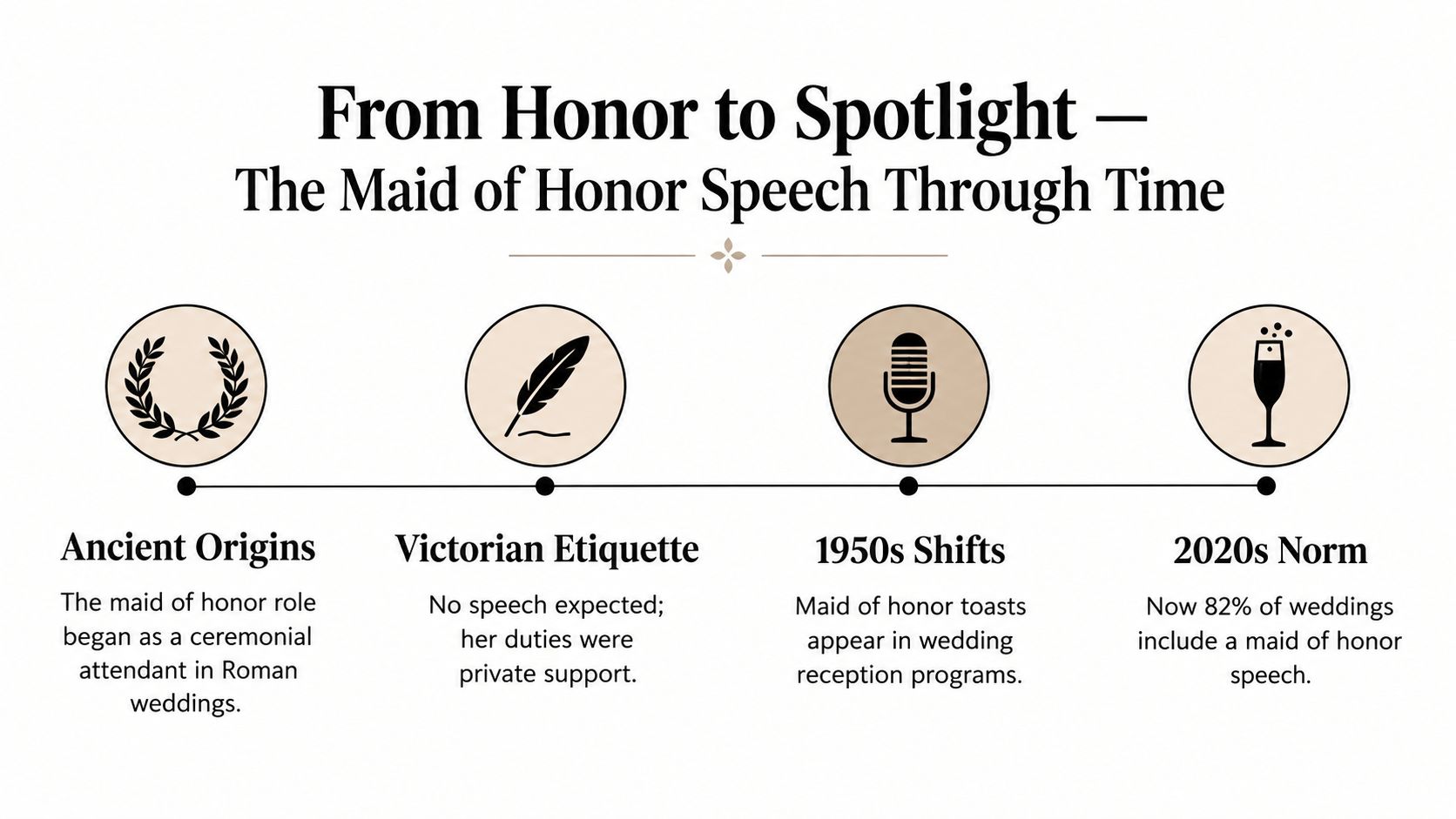
The maid of honor's title is older than the modern reception speech. Historically, she served as a ceremonial attendant and close support for the bride. A formal speaking assignment wasn't an ancient requirement attached to the role, which helps explain why older etiquette references may not treat her toast as a fixed part of the wedding.
Modern receptions have added new “tracks” to the program. Think of the event as a playlist. Earlier versions often centered on a small group of formal speakers, while today's version may include the best man, maid of honor, parents, siblings, friends, or the couple themselves. The maid of honor has moved from standing beside the bride to becoming a personal witness who can tell the room what the bride is like and why the relationship matters.
Why the custom feels like a rule
Etiquette becomes confusing when a common practice looks compulsory. Current wedding guidance describes the maid of honor as a recognized speaker in many English-speaking wedding markets, especially the U.S. and U.K., while also making clear that no historical rule requires her to give a speech. Bridebook's maid of honor speech advice presents the role as structured but flexible, with accepted guidance for length, content, and balance.
That combination creates the modern answer:
- The speech is common: Many contemporary reception programs include it.
- The speech is planned: Couples often place it near the best man's remarks.
- The speech is adaptable: The length, tone, and order can change.
- The speech is optional: The couple can remove it without breaking formal etiquette.
A wedding's traditions should serve the people getting married. If the bride feels uncomfortable with public speaking, if the reception schedule is tight, or if the couple wants a quiet dinner without formal remarks, skipping the maid of honor speech is a reasonable choice. If they want the speech, they can still make it easy by setting a clear time limit and approving sensitive material in advance.
Who Gives Speeches and Where the Maid of Honor Fits In
The easiest way to decide whether you should speak is to identify the wedding's speech format. Don't start with the title “maid of honor.” Start with the reception the couple wants to create.
A formal wedding may use a traditional lineup. A semi-traditional wedding may include the maid of honor alongside the best man and parents. A nontraditional wedding may give the couple, friends, or selected guests equal control over the microphone.
Modern wedding speech lineups compared
| Wedding Format | Typical Speakers in Order | Maid of Honor Role |
|---|---|---|
| Traditional | Parent or parents, best man, maid of honor, then a closing toast or couple remarks | Usually gives a brief personal speech, often near the best man |
| Semi-traditional | Selected parents, best man, maid of honor, siblings, or close friends | Speaks as one planned voice among several |
| Nontraditional | Couple, chosen friends, family members, or no formal speakers | May give a short toast, share a joint message, or skip the microphone |
The exact order isn't universal. ToastWiz's wedding speech order guidance explains that the maid of honor is often placed immediately before or after the best man, and that couples may choose the closer based on which speech is expected to land more effectively. That's a programming decision, not a judgment about whose role matters more.
Match the lineup to the room
Consider three practical questions:
- How formal is the reception? A formal dinner may benefit from a clearly scheduled series of toasts. A casual gathering may work better with one short group toast.
- How many people are speaking? If several guests have prepared remarks, your contribution may need to be tighter.
- What does the couple want? Their preference outranks a generalized tradition.
Cultural expectations can also vary, even among families living in the same country. One side may expect speeches from parents, while the other may see them as optional. Ask the couple and, if needed, the planner or emcee. You're looking for a confirmed run-of-show, not permission from an imaginary etiquette committee.
How Long Your Speech Should Be and When to Give It
Once you know you're speaking, settle the clock before you settle the wording. A speech that fits the reception feels generous. One that runs long can make dinner, dessert, dancing, and the other speakers compete for room.
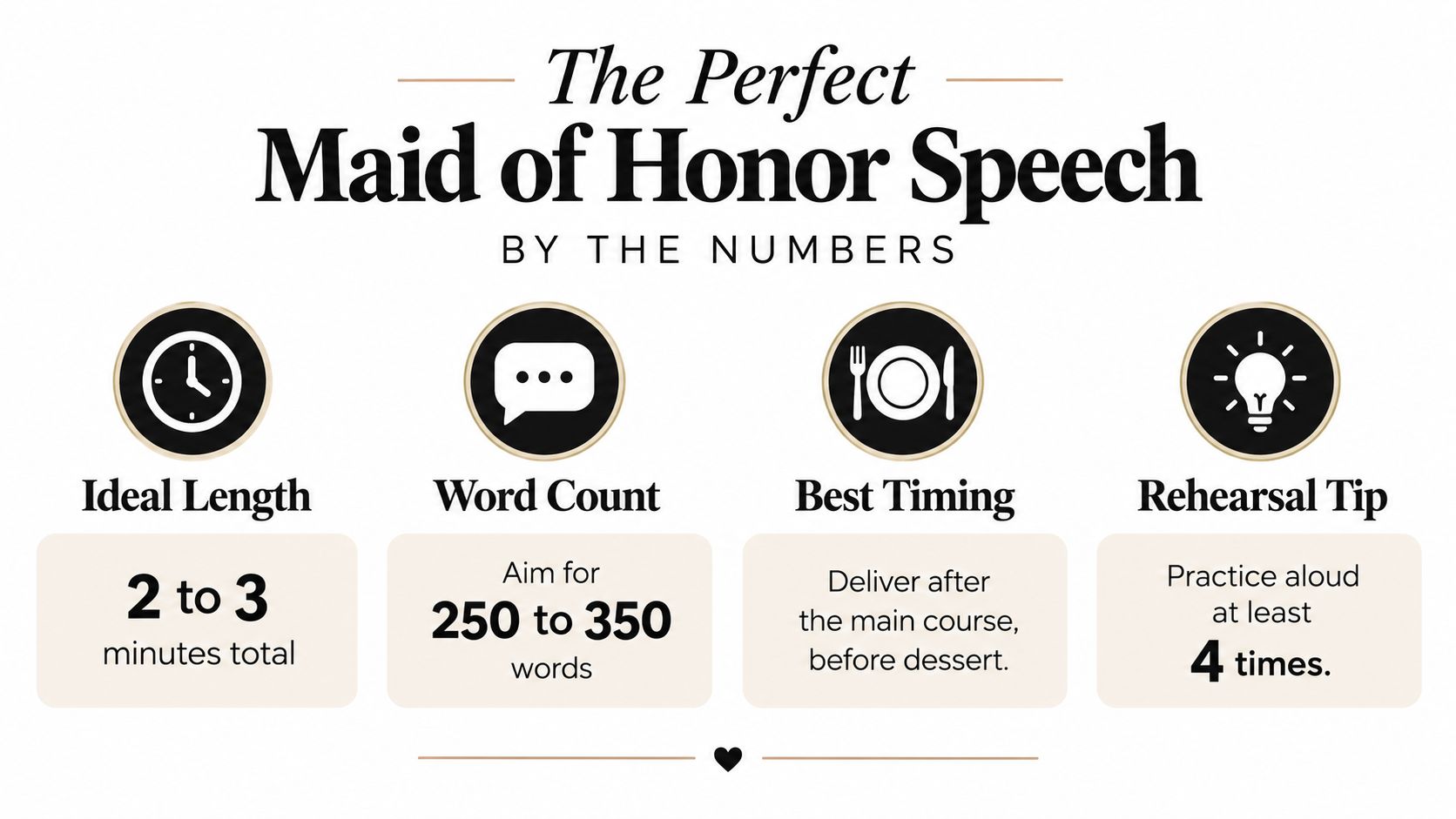
Current guidance gives a bounded range. Some sources recommend 2–3 minutes, with 5 minutes as a ceiling, while other etiquette advice allows 5–7 minutes and suggests roughly 700–900 words for that longer delivery. ToastWiz's complete maid of honor speech guide also frames the speech as a concise set piece, commonly lasting 3–5 minutes.
Choose your target before drafting
Use the couple's program to choose your limit:
- Short program: Aim for the shorter end of the accepted range.
- Several speakers: Keep your remarks compact so the reception maintains momentum.
- Only or primary toast: Ask whether the couple wants a little more room.
- Unclear timing: Start with a short draft. It's easier to add one meaningful detail than remove five wandering paragraphs.
For more context on planning a speech around a time limit, see this practical guide to how long a wedding speech should be.
Confirm your place in the program
The maid of honor commonly speaks after or near the best man, but the couple, planner, DJ, or emcee should confirm the actual order. Ask when you'll be introduced, whether you'll use a microphone, and whether you should stand at your table or walk to a designated speaking area.
Practice with a timer, aloud. Silent reading hides long sentences, rushed transitions, and emotional pauses. Rehearsing helps you discover whether your warm closing takes longer than expected and gives you a chance to trim without panic.
Practical rule: Write for the time you've been given, then rehearse for the room you'll actually enter.
What to Say and How to Sound Like Yourself
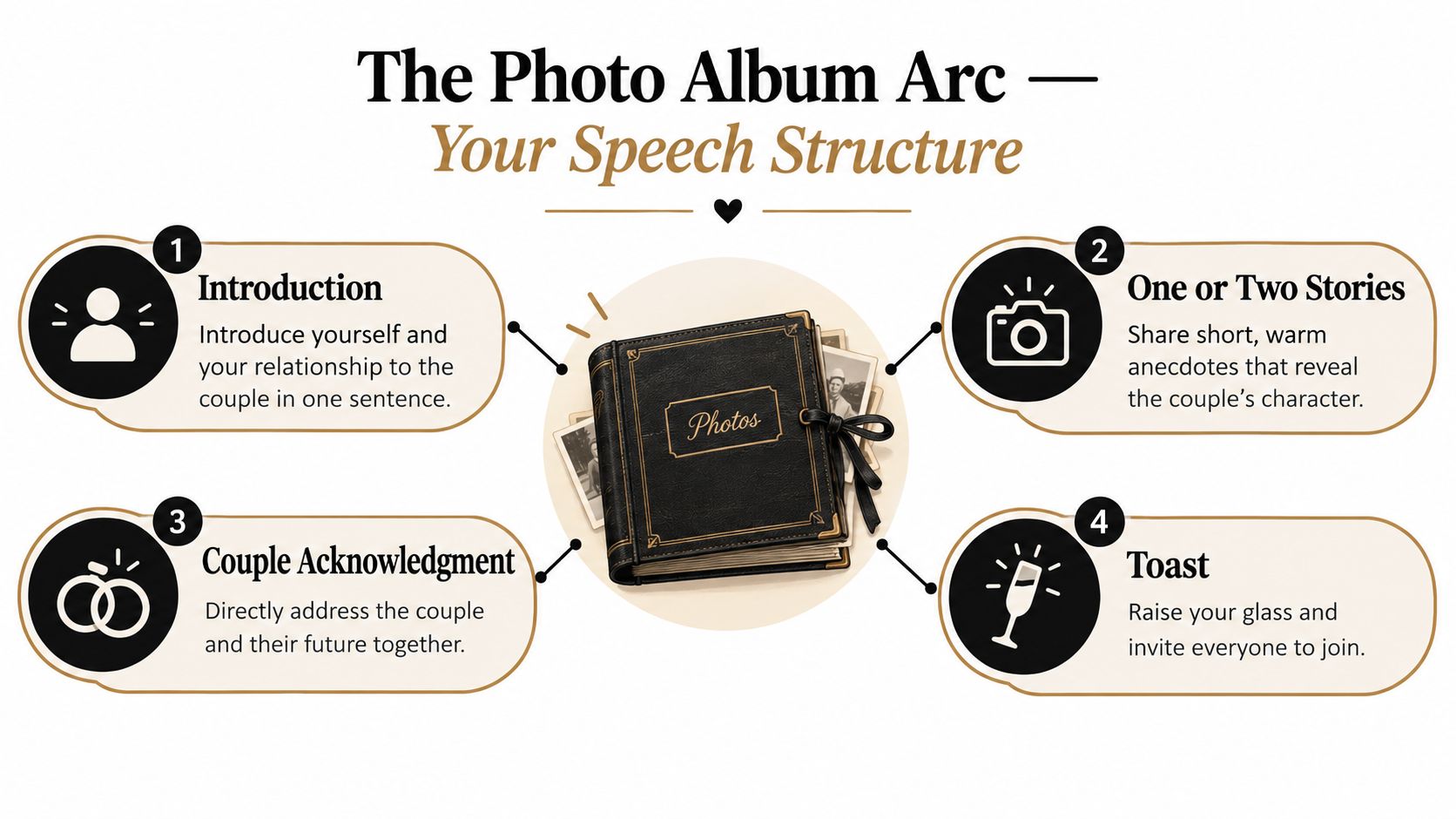
A strong maid of honor speech works like a small photo album, not a résumé. A résumé lists achievements. A photo album chooses a few moments that reveal a person. Your speech should do the same by selecting one or two memories that show who the bride is, how the partner fits into her life, and why the couple deserves celebration.
The most consistent structure is simple:
- Introduce yourself. Say your name and explain your relationship to the bride or couple.
- Share one or two stories. Choose memories that reveal character, not merely chaos.
- Acknowledge the couple. Turn from your relationship with the bride toward the marriage.
- Close with a toast. Invite guests to raise their glasses and give the evening a clear ending.
Build the middle around evidence
Generic praise sounds pleasant but disappears quickly. “She's kind” is a conclusion. A memory of her showing up for a friend, calming a stressful situation, or making everyone feel included gives the room evidence for that conclusion.
Try this prompt: What happened that proves the quality I want to describe? Then tell the story in a few clean beats:
- Where were you?
- What did the bride do?
- What did that action reveal?
- How does that quality connect to the couple?
Content guidance often recommends that around two-thirds of the speech focus on stories illustrating the bride's character, with a smaller share acknowledging the partner and the relationship. Another approach suggests a 70% / 30% balance between the honoree and the other partner. Bridebook's speech guidance presents these as useful norms, not inflexible rules.
Keep humor safe and inclusive
You don't need to perform comedy. A gentle observation, a funny habit, or a small self-deprecating moment can add warmth, but the joke should help guests understand the bride rather than embarrass her.
Leave out ex-partners, private details, risky stories, and inside jokes that exclude most of the room. If a story needs a long explanation, choose another story. A good test is whether the bride would feel respected if the words appeared in the wedding video years later.
Use the final transition to name something specific about the partner. Then raise your glass and make the toast about the couple's future, not just your history with the bride.
If You Do Not Want a Solo Speech Smart Alternatives That Still Honor the Couple
Public speaking anxiety doesn't disappear because you love the bride. You can be honored to serve as maid of honor and still feel unable to stand alone with a microphone. That conflict deserves a practical solution, not guilt.
Modern couples are also reconsidering how many speeches they want. Recent wedding-speech trend data reports that 57% of couples prefer fewer speeches, 38% plan to edit or vet speeches in advance, and 68% say speeches create more anxiety than the ceremony, according to Speechy's 2026 wedding speech trends. The same source reports that 94% would hate an ex being mentioned, which reinforces the value of emotional safety and pre-agreed boundaries.
Options that reduce the pressure
- Co-toast: Share the microphone with another bridesmaid. Divide the speech into two natural voices, or let one person tell the story while the other delivers the toast.
- Short toast: Offer a brief message instead of a full address. One meaningful memory, one sentence about the partner, and a raised glass can feel complete.
- Recorded video: Film a warm message for the couple to watch during dinner. Confirm the format and playback plan with the planner before choosing this option.
- Written letter: Give the couple a handwritten letter privately. This works especially well if your feelings are easier to express on paper than in front of a room.
- Group tribute: Organize a collective cheer, song, or short message with other wedding-party members, but get approval before turning it into a surprise.
The decision can be simple. If your anxiety is high, choose a shared or written format. If the schedule is tight, choose a short toast. If the couple wants formal remarks but you don't want to speak alone, suggest a co-toast.
Ask without spoiling the warmth
Tell the couple early and directly: “I want to honor you, but a solo speech feels overwhelming. Would you be open to a co-toast or a short message?” This gives them control while showing that you're still looking for a way to participate.
If they prefer no speech, accept that answer with relief rather than embarrassment. Your role includes protecting the couple's experience, and sometimes the kindest contribution is helping the reception stay comfortable and focused.
For help shaping a brief shared message, this guide to how to write a wedding toast offers a useful starting point.
Your Next Steps From Blank Page to Confident Toast
You don't need to write the perfect speech in one sitting. You need a confirmed assignment, a clear time limit, and a few memories that only you can tell.
Start with a quick message to the couple:
“Would you like me to speak? If yes, what time limit, tone, and order should I plan for?”
Then open a notes app or sheet of paper and write answers to these prompts:
- What is one moment that captures the bride's character?
- When did I first see that the partner was important to her?
- What do I admire about them together?
- What do I hope they carry into married life?
Set a short drafting timer. Spend the first few minutes listing memories without judging them. Spend the next few minutes choosing one story and connecting it to a quality. Use the final minutes to write a direct toast. You'll have a rough shape before perfectionism gets a vote.
A simple fill-in framework
“Good evening, everyone. I'm [name], and I'm [relationship] to [bride or couple]. One thing I love about [bride] is [quality], and I saw it clearly when [specific memory]. When I watch [bride] and [partner] together, I see that same quality in [specific observation]. Please raise your glasses to [couple], and may your life together be filled with [specific wish].”
That's a scaffold, not a script. Replace every bracket with language you'd use. Read it aloud, remove anything that sounds borrowed, and keep the details that make the bride smile.
If the blank page still feels impossible, Honored Words' maid of honor speech guide can help turn guided memories into a polished draft you can revise for tone and length. You'll still be the person supplying the meaning. The tool gives those memories a workable shape.
Honored Words uses guided questions to help you turn specific memories and inside jokes into personalized wedding speech drafts, with options for tone and revisions. Visit Honored Words to preview a custom opening and move from blank page to a toast you'll feel ready to deliver.
Related speech guides
Continue with a free draft for the occasion that matches this article.
Turn your story into a speech.
Answer a few guided questions, compare three personalized drafts, and edit until the words sound like you.
Start your speech